

In applications such as smart meter backup and server power ride-through, the batch-to-batch consistency of supercapacitors often determines the operating life and reliability of the entire module. Although the traditional wet‑coating process is mature, its inherent micro-scale non-uniformity frequently becomes a performance bottleneck. The TSE series coin-type supercapacitors from UF Capacitors adopt an advanced dry-electrode manufacturing process, fundamentally reinventing the electrode-forming method and turning cycle life, batch consistency, and long‑term reliability into quantifiable engineering advantages.
Wet Coating: The Engineering Trade-Offs Behind a Mature Process
Traditional supercapacitor electrodes are commonly manufactured using wet coating: activated carbon, conductive agents, and binders are mixed with organic solvents to form a slurry, coated onto aluminum foil, and then baked at high temperature to remove the solvents. Behind this seemingly mature process lie three core defects caused by solvents:
Binder migration: During drying, solvent evaporation drives binders toward the electrode surface, causing uneven distribution of active material across the thickness direction and weakening the conductive network in certain regions.
Residual solvent and moisture: Trace amounts of solvent and moisture are extremely difficult to remove completely. They not only increase internal resistance but also trigger side reactions with the electrolyte, slowly corroding the aluminum foil and degrading capacitance.
Micro-cracks: Drying stress readily creates micro-cracks in the electrode. These defects gradually propagate during long-term charge-discharge cycling, ultimately severely compromising cycle life.
How the UF TSE Series Breaks Through with Dry‑Electrode Technology
The UF TSE series completely abandons the solvent route and uses a dry-electrode manufacturing process: through dry mixing and calendering, the active material and binder are directly formed into a self-supporting electrode film, which is then thermally laminated onto the current collector. No solvent is involved throughout the entire process, thus fundamentally eliminating the three defects described above.
The dry-electrode technology offers five key advantages:
Consistency and Cycle Life: How Microstructure Drives Macro Performance
In the dry-electrode film, the binder forms a fibrous, uniform network and the activated-carbon particles are in intimate contact, without the binder-rich or binder-poor regions typical of wet-coated electrodes. This microstructural difference directly translates into two key engineering advantages:
Significantly improved batch consistency: The dry-electrode film exhibits excellent density uniformity, resulting in a tighter capacitance tolerance from cell to cell. In series-connected modules, the voltage distribution across individual cells is more balanced, effectively reducing the reliance on external balancing circuits and simplifying system design.
Greatly extended cycle life: With no solvent residues to trigger side reactions inside the electrode, charge-discharge reversibility is extremely high. The TSE series achieves a cycle life of over 100,000 cycles, far exceeding that of conventional wet-process supercapacitors, providing a solid guarantee for long-term maintenance‑free operation.
For applications requiring long-term maintenance-free operation, such as RTC clock backup and industrial meters, this translates into considerable savings in total system life-cycle cost.
Low Leakage Current: The Invisible Guarantee for Long‑Term Standby in Battery‑Powered Devices
Another key characteristic of the TSE series is its low leakage current. When the embedded system loses power, the supercapacitor self-discharges at a very low rate, sufficient to maintain the real‑time clock and SRAM data for hours or even days. For battery-or energy-harvesting-powered devices such as NB-IoT sensors and smart water meters, this feature directly affects data integrity and field-maintenance intervals, making it a critical parameter that cannot be overlooked during component selection.
Typical Applications and Quick Selection Guide for the TSE Series
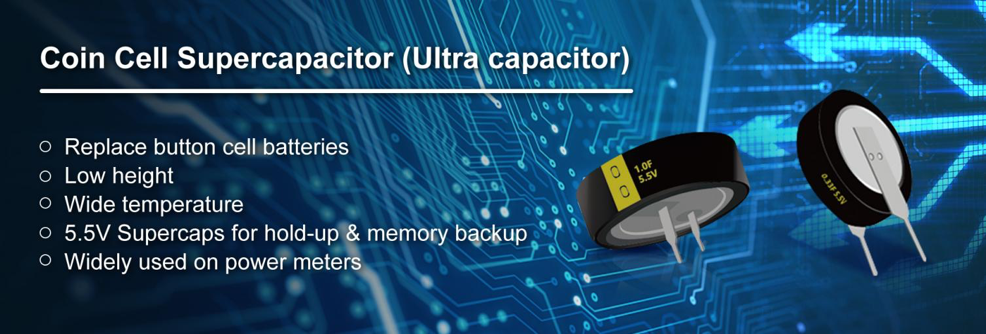
Three core application directions for the UF TSE series: real-time clock backup, memory backup, and ride-through power. In smart meters, TSE supercapacitors provide sufficient hold-up time for the metering chip and communication module during a power outage, ensuring transaction data is fully saved and uploaded. In EV charger payment systems, TSE similarly handles the final billing confirmation when power is lost. Medical equipment, automotive electronics, and many other fields also benefit from its high reliability and long life.
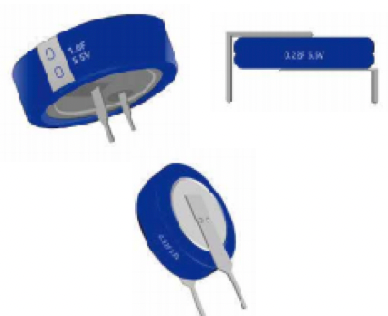
The TSE series is available in three industry-standard package styles – cylindrical mount, horizontal mount, and vertical mount – with key parameters as follows:
Summary
By employing a dry-electrode manufacturing process, the UF TSE series coin-type supercapacitors fundamentally resolve the inherent weaknesses of wet coating in consistency, cycle life, and long-term reliability. From microscopic electrode structure to macroscopic system performance, this process innovation enables supercapacitors to deliver greater engineering value in RTC backup, smart meters, EV chargers, and industrial ride-through applications. For design engineers pursuing maintenance‑free operation, extended service life, and high reliability, the TSE series offers an ideal choice that combines technical depth with commercial competitiveness.
Please visit www.ufcapacitors.com or email us directly at karin@topdiode.com with your requirements. We will respond within 24 hours.
Cross to:
|
Photo |
UF Capacitors |
Vishay |
Eaton |
ELNA |
Panasonic |
Cornell Dubilier |
|
|
Coin Type TSE series |
196 DLC series |
KR series |
DSK series |
SG Series |
EDC Series |