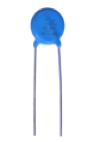


Metal Oxide Varistor (MOV) is widely used for surge protection in electronic products. One key parameter we often ignore is Typical Capacitance (reference) @1KHz. For sales engineers and electronic buyers, knowing this value well helps select correct MOV models for different applications, especially for meters like electricity meters, water meters and energy meters. It is important to master the meaning of this parameter and its selection rules to ensure the stable operation of electronic devices.
First, let’s understand what Typical Capacitance means. This parameter shows the parasitic capacitance of a varistor tested at 1KHz, with the unit pF. It is a reference value instead of a strict standard, which means we don’t need to strictly control its exact value during purchase, but it has a great impact on the performance of the circuit. From our product specification sheet, we can see a clear rule: MOVs with lower varistor voltage have higher capacitance. For example, VAR07D431K has 115pF, while high-voltage VAR07D911K only has 55pF. This is a natural physical feature of zinc oxide ceramic material, which is easy to remember and apply in actual selection.
A basic question comes: is higher capacitance better or lower? There is no absolute answer. The choice fully depends on your working circuit. We can simply divide applications into two main types: low-frequency power protection and high-frequency signal protection. Mastering the characteristics of these two types of circuits can help us quickly select the right MOV models.
For low-frequency power supply circuits, we choose high-capacitance MOVs. Low-frequency circuits mainly supply power for devices, such as household power adapters, chargers, distribution boxes and industrial power input. They work at 50Hz or 60Hz mains electricity with slow speed. High-capacitance MOVs can absorb more surge energy in a short time. They effectively suppress sudden high-voltage spikes caused by lightning strikes or power-switch noise, protecting the internal components of the device from damage. Since power circuits do not transmit fast data signals, large capacitance will not cause negative effects on normal power supply. For normal AC power protection, models like VAR07D471K and VAR07D431K with 105–115pF are perfect choices. They balance protection performance and cost very well, which are widely used in daily and industrial power protection.
For high-frequency signal circuits, we must choose low-capacitance MOVs. High-frequency circuits are used for data communication and signal transmission, including network lines, sensor wires, 485 communication ports and high-speed control lines. Their working frequency is much higher than mains electricity. If we use high-capacitance varistors here, parasitic capacitance will block fast signals. It will lead to signal attenuation, waveform distortion, data loss and unstable communication, which will affect the normal operation of the device. Low-capacitance MOVs only suppress dangerous surge voltage and keep normal high-speed signals stable. Models with 55–65pF like VAR07D911K and VAR07D821K are ideal here, which are suitable for surge protection of high-frequency precision equipment.
Now we focus on a typical application: electricity meters, water meters and energy meters. These smart meters have two core circuits: power supply circuit and measurement & communication circuit. The power part is low-frequency mains input, which could use high-capacitance MOVs in theory, but the meter core has pulse measurement signals and 485 remote reading signals, which belong to high-frequency weak-electric signals. If we use high-capacitance MOVs over 100pF, large parasitic capacitance will interfere with metering accuracy and remote data transmission. It will cause wrong measurement, failed data uploading and unstable meter performance, which is unacceptable for meters that require high precision and stability.
So we have clear selection rules for meters. For simple meters without remote communication functions, such as ordinary mechanical meters, high-capacitance models like VAR07D471K are acceptable for basic power surge protection. For common smart meters with general communication functions, we recommend mid-low capacitance models VAR07D621K and VAR07D681K, with capacitance from 75pF to 80pF. They balance surge protection ability and signal stability perfectly, which are the most commonly used models in the meter industry. For high-precision smart meters with strict 485 remote reading requirements, we must choose low-capacitance models such as VAR07D781K and VAR07D821K (55-65pF). These models will not affect metering precision at all and can ensure the stability of remote data transmission.
In addition, there are two key points for MOV selection. First, capacitance is closely linked to varistor voltage: higher-voltage MOVs have lower capacitance by nature, which is a fixed physical characteristic. Second, Typical Capacitance is only a reference value, so we only need to choose the correct capacitance range according to the application scenario, instead of pursuing the exact value. This can help us improve selection efficiency and reduce unnecessary troubles.
In short, when selecting MOVs, follow this simple rule: power supply protection needs high capacitance, while signal and meter protection needs low capacitance. By checking whether the customer’s product is for power supply or signal transmission, we can quickly match suitable varistor models. This guide helps electronic engineers and buyers choose proper surge protection components efficiently, ensuring the stable and safe operation of electronic devices. Whether it is daily power equipment or precision smart meters, selecting the right MOV according to the capacitance parameter.
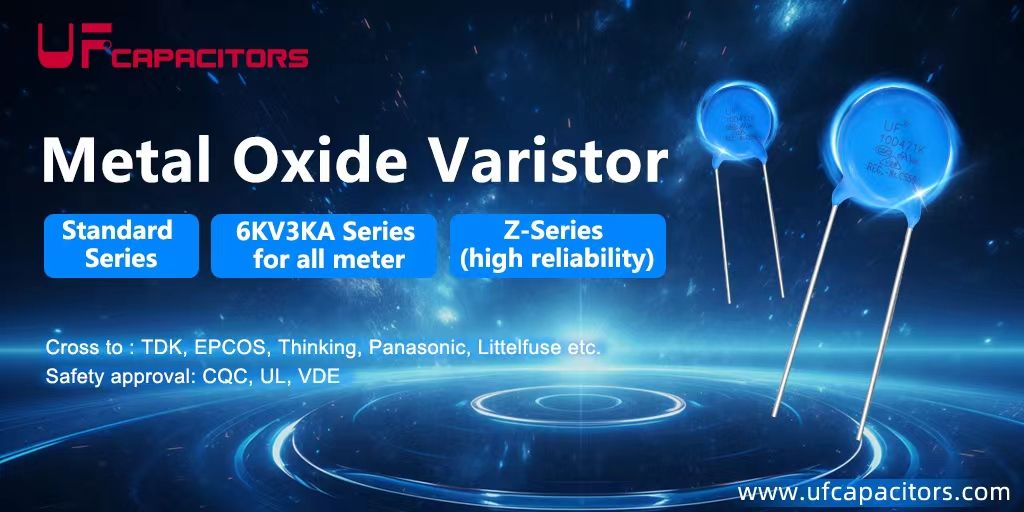
UF Capacitors supply standard series MOV, and high level Z series MOV, 6KV3KA series MOV. UF Capacitors MOV, with full safety approval: CQC, UL, VDE etc, can cross to #TDK, #EPCOS, #Thinking, #Panasonic, #Littelfuse etc, but with better price and lead time.
|
Photo |
UF Capacitors |
Vishay |
Littelfuse |
Panasonic |
TDK/EPCOS |
Thinking-TVR |
|
|
VAR Series |
VDR Series |
#LA Series #ZA Series |
ERZE**D***K Series |
B722**S***K Series |
TVR Series |