

In industrial power supplies, telecom base stations, photovoltaic inverters, EV chargers, and motor drive systems, engineers fear not circuit malfunction, but the protection component itself failing first—a single lightning strike, one grid fluctuation, or an emergency motor stop can send an entire device up in smoke.
The culprit is often not the lack of protection, but incorrect Metal Oxide Varistor (MOV) selection. Especially for high energy applications, if you only focus on the 8/20μs peak current while ignoring the 10/1000μs energy rating, your equipment is like wearing a raincoat into a swimming pool—completely mismatched protection.
Today, starting from the working principles of MOVs and using the specifications from UFcapacitors Z Series High Energy Varistors, we will lay out a complete methodology for high energy MOV selection.
1. How Does a Varistor (MOV) Work?
1.1 What is a Varistor?
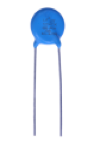
A Metal Oxide Varistor (MOV) is a voltage-dependent resistor. Its core material consists of zinc oxide (ZnO) grains separated by grain boundary layers.
Under normal operating voltage, the grain boundaries exhibit high resistance with minimal leakage current (microamperes)—the MOV acts as an open circuit. When a surge overvoltage occurs, the grain boundaries break down, and the resistance drops instantly to a low-impedance state (nanosecond response), shunting the surge current to ground and clamping the voltage across the protected circuit to a safe level.
Think of it as an intelligent floodgate:
* Normal conditions: Water (current) flows through the main channel; the gate remains closed
* When flood (surge) arrives: The gate opens instantly, diverting floodwater to a retention basin, protecting downstream villages (sensitive circuits)
1.2 Why Do MOVs Fail?
MOV failure mechanisms fall into two main categories:
Key Insight: Standard MOVs often fail first in high energy, long duration surge scenarios (like lightning strikes, motor back-EMF, grid switching operations) due to insufficient energy absorption capability.
Many engineers select MOVs based solely on maximum peak current (8/20μs waveform)—choosing a 6000A or 10000A part seems sufficient. However, different surge waveforms have drastically different impacts on MOVs.
2.1 Understanding Two Key Waveforms
|
Waveform |
Rise Time |
Duration |
Simulated Scenario |
Impact on MOV |
|
8/20μs |
8μs |
20μs |
Induced lightning, ESD |
High peak current, but relatively low energy |
|
10/1000μs |
10μs |
1000μs |
Grid switching, motor coil discharge, long-tail lightning |
Lower peak current, but massive energy |
For MOVs, the 10/1000μs waveform is the true "energy killer." If an MOV's energy rating (Joules) is insufficient under 10/1000μs long-wave冲击, heat will accumulate internally, leading to thermal runaway.
2.2 Typical High Energy Application Scenarios
Equipment requiring careful attention to 10/1000μs energy ratings includes:
*Industrial Switch Mode Power Supplies: Frequent grid fluctuations require tolerance to long-duration surges
*Photovoltaic Inverters: DC side susceptible to induced lightning with long energy duration
*EV Charging Stations: Complex energy exchange between grid and vehicle during high-power charging
*Motor Drives/VFDs: Motor emergency stop releases stored coil energy as back-EMF, forming long-wave surges
*Telecom Base Station Power Supplies: Outdoor installation with high risk of direct and induced lightning
3. UFcapacitorsZ Series High Energy Varistors: Engineered for Demanding Applications
Addressing the stringent requirements of high energy applications, UFcapacitorsintroduces the VAR Series Z Series (High Energy) Metal Oxide Varistors. These are not ordinary MOVs but enhanced products specifically designed for high surge, high energy, high reliability scenarios.
Key Advantages of UFcapacitorsZ Series:
20D series delivers 10000A 8/20μs surge capability with 10/1000μs energy ratings consistently exceeding 200J, reaching up to 266J (VAR20D751K*Z)—significantly outperforming standard products at 150J-200J.
Operating temperature -40℃~+105℃, storage temperature -40℃~+150℃, maintaining low leakage current and long life in both hot enclosures and freezing outdoor conditions.
Complete portfolio from 5D (400A/21J) to 25D (10000A+/390J), meeting all application needs from board-level to system-level protection.
Certified with UL, cUL, VDE, and CQC—four major global certifications across all mainstream models, helping your end equipment pass compliance testing faster.
4. Conclusion: Choose the Right MOV—Buy Insurance for Your Equipment
A tiny varistor often represents the last line of defense for equipment safety. In high energy, high reliability industrial applications, selecting the right MOV means buying "disaster insurance" for your product—invisible in normal times, life-saving in critical moments.
UFcapacitors VAR Series Z Series High Energy Varistors, with their superior energy ratings, wide temperature range, and global safety certifications, are your reliable partners in meeting stringent surge challenges.
Whether you are designing industrial power supplies, photovoltaic inverters, EV chargers, or motor drive systems, we welcome you to download the complete datasheet or contact our application engineers for selection support.
Cross to:
|
Photo |
UF Capacitors |
Vishay |
Littelfuse |
Panasonic |
TDK/EPCOS |
Thinking-TVR |
|
|
VAR Series |
VDR Series |
LA Varistor Series |
ERZE**D***K Series |
B722**S***K Series |
TVR Series |